Fat Grafting vs. Biostimulators
Volume & Skin Regeneration Modern aesthetic medicine has shifted from simply filling space to actively regenerating tissue.
Here is how Traditional Fat Grafting and Biostimulators compare for facial rejuvenation.
1. Core Mechanisms
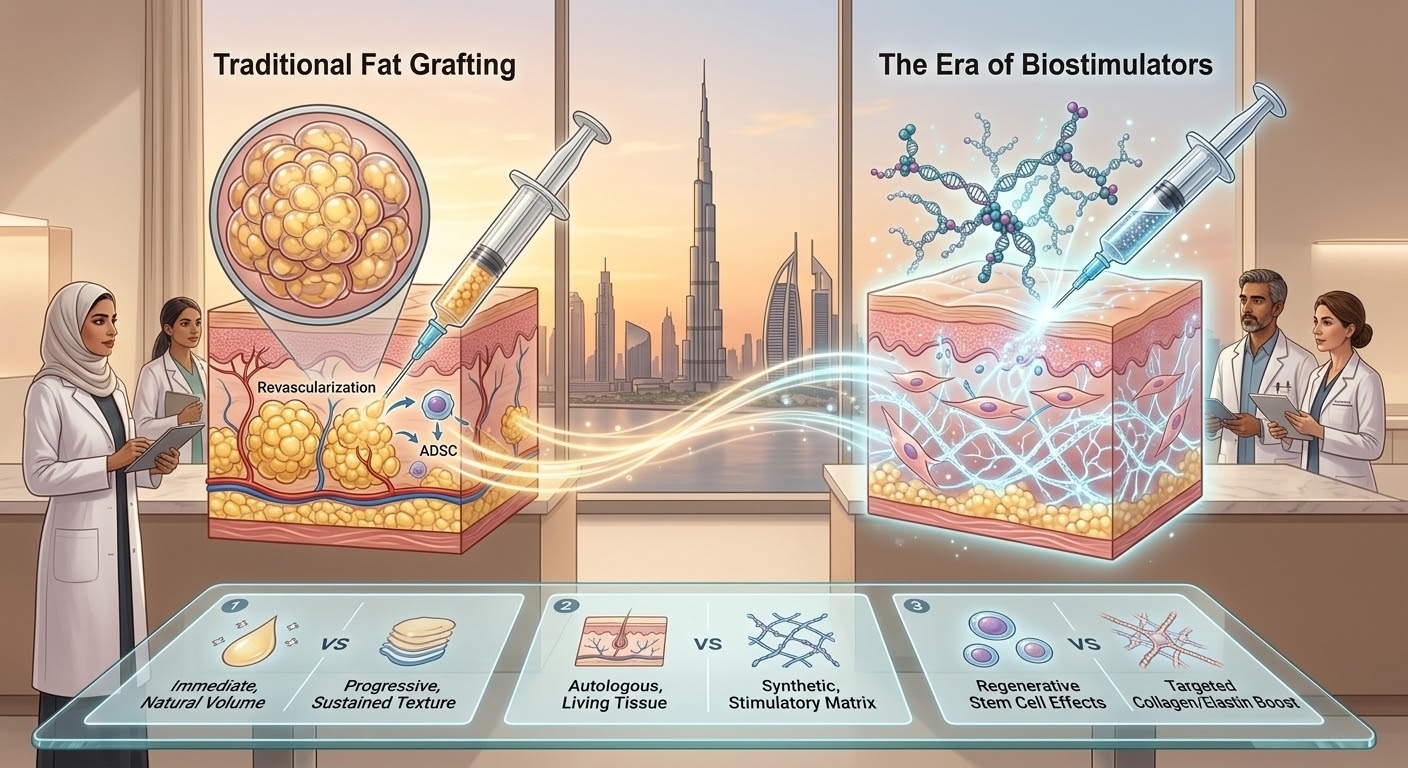
* Traditional Fat Grafting: Harvests living autologous fat cells and stem cells (ADSCs) via minor liposuction to restore lost structural volume.
* Biostimulators: Injectable compounds (e.g., PLLA, CaHA, Polynucleotides) that stimulate the body’s own collagen and elastin production.
2. Key Differences
* Source: Fat grafting uses 100% autologous living tissue; biostimulators use lab-engineered bio-active matrices.
* Results: Fat grafting gives immediate, major volume restoration; biostimulators deliver progressive improvements in skin density, elasticity, and texture.
* Downtime: Fat grafting requires donor-site harvesting with a few days of recovery; biostimulators are quick in-office treatments with minimal downtime.
* Ideal Candidates: Choose fat grafting for deep structural volume loss (temples, cheeks); choose biostimulators for fine lines, skin laxity, and subtle rejuvenation.
3. Clinical Synergy: Combining Fat & Biostimulatory Concepts Hybrid Approaches:
Modern regenerative protocols often integrate the structural foundation of fat grafting with the micro-textural refinement of biostimulating agents. Tissue Longevity: While fat grafting anchors large-scale volumetric restored contours, biostimulators maintain skin quality, firmness, and dermal density over time.
Tailored Treatment Plans: A personalized consultation determines whether a patient benefits more from fat tissue transfer, non-surgical biostimulation, or a strategic combination of both.
If you want to learn more or are considering treatment for any aesthetic, skin, or hair condition, book your consultation in-clinic or online at The Dermis today.
Download The Dermis app to explore treatments, book appointments, access teledermatology consultations, and manage your personalized skin journey right from your device.
Frequently Asked Questions (FAQs)
Q1: Which lasts longer, fat grafting or biostimulators?
Fat grafting provides permanent results once the transferred fat cells establish blood supply (usually within 3 to 6 months). Biostimulators produce results that typically last between 18 to 24 months, depending on the product used and individual metabolism, requiring periodic maintenance.
Q2: Can I combine fat grafting and collagen biostimulators?
Yes. Combining both treatments is common in regenerative aesthetic protocols. Fat grafting builds deep structural foundation and volume, while biostimulators refine surface skin texture, density, and elasticity.
Q3: Are biostimulators safer than facial fat transfer?
Both treatments have high safety profiles when performed by an experienced specialist. Biostimulators are non-surgical and carry minimal downtime, making them lower risk for surgical complications. Fat transfer is 100% natural using your own tissue, eliminating risks of allergic reactions or product rejection.
Q4: How soon will I see results from biostimulators compared to fat transfer?
Fat transfer shows immediate volumetric changes, though final results stabilize after a few months. Biostimulators work progressively; initial volume from hydration settles quickly, with true collagen building becoming visible over 4 to 12 weeks.